
El-Sayed Performed About the Same As Other Michigan Democrats
Ahead of the midterms, a particular bloc of self-styled moderate liberal commentators, headed by Yglesias, became a bit obsessed with Abdul El-Sayed. Their concern was basically as follows:
- El-Sayed is a progressive who did not follow moderate prescriptions for how to win.
- Despite (1), El-Sayed could very well win, not because moderates are wrong about how to win but because election outcomes are driven by many factors beyond the personal politics or stylings of a particular candidate.
- Yet, if El-Sayed does win, many pundits would not understand (2) and thus wrongly conclude that El-Sayed's approach is not an electoral liability.
As part of bracing for this outcome, this particular bloc did a lot of work ahead of the election explaining the concept of underperformance. Elections are binary events where getting 51 percent of the vote yields the same outcome as getting 60 percent of the vote. But if, relative to some counterfactual, a candidate gets 51 percent instead of 60 percent, they still underperformed by 9 points, even if they managed to win due to other factors.
This, they argued, is what was going to happen to El-Sayed.
But it didn't. In the graph below, I have plotted El-Sayed's vote share alongside the Democratic vote share in the three other statewide elections in Michigan and the aggregate Democratic vote share across all Michigan U.S. House races.
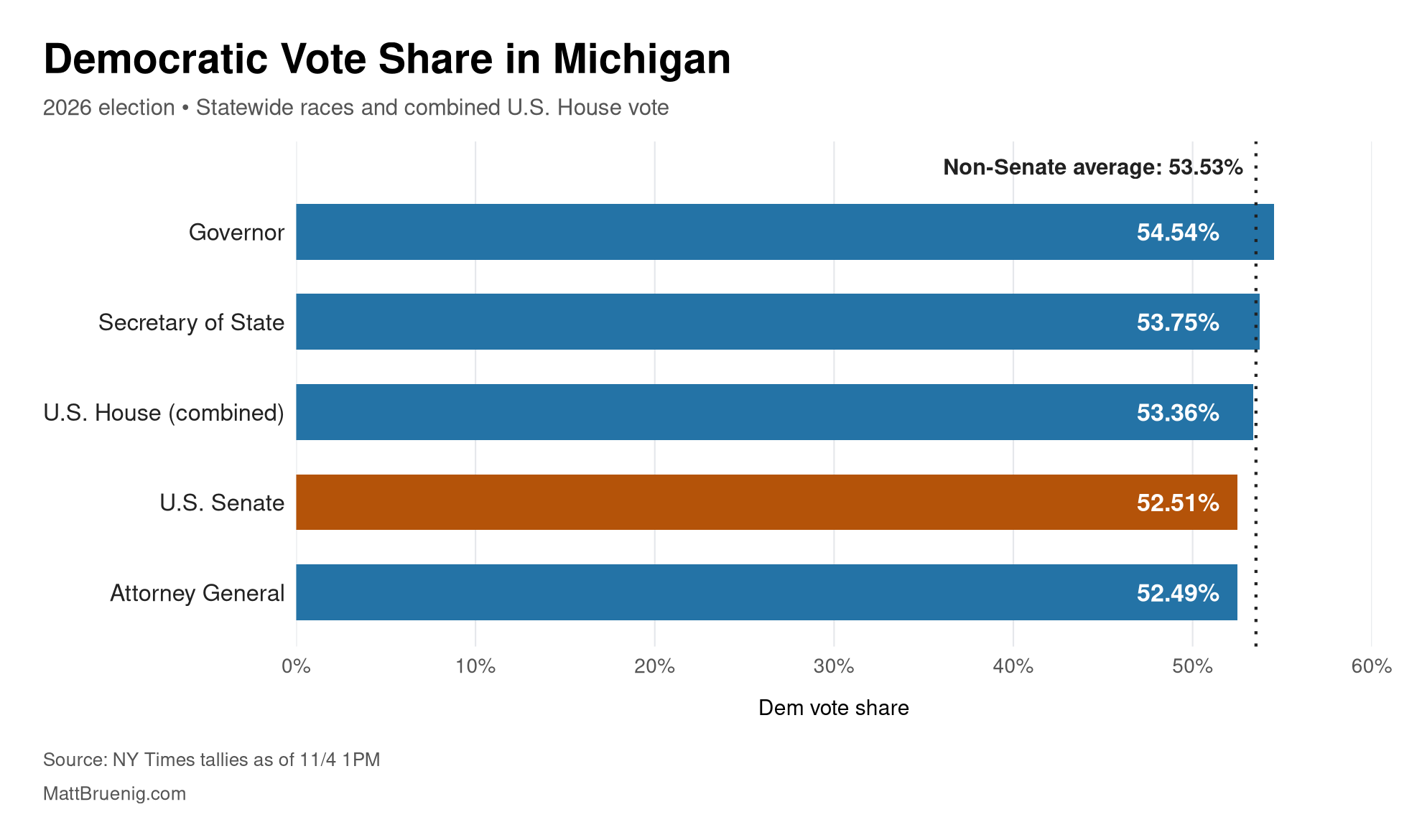
All of the vote shares are clustered together within a 2pp band. A simple average of the non-Senate races gives Democrats 53.5 percent of the vote share. El-Sayed was just one point shy of that, at 52.5 percent. If you make even the tiniest of allowances for the sui generis aspects of the El-Sayed race that are not related to his progressivism per se, then there is no way to hang any significance on this single percentage point.
Any non-motivated look at the current vote tallies would conclude that El-Sayed basically ran the same as Democrats in Michigan more generally.