
Yglesias, Israel, and Moderation
One of Matt Yglesias's defining political positions is that Democrats should be more moderate in order to attract more votes. This is generally invoked as a critique of the left and so naturally attracts left-wing ire, which Yglesias seems to enjoy.
One issue I've long had with this moderation-or-not discourse is that it's a moving target. If we define moderate as something like the median of the current distribution of political views (ignoring all the complications with that concept), then there must be people who organically and earnestly hold those specific views. Yet those people are only moderates for as long as their views happen to be at the median. If the underlying distribution of views changes, which it does, then people who were formerly moderates, so defined, no longer are.
But the people who advocate moderation, like Matt Yglesias, are almost never moderate in this organic sense. Yglesias's views, e.g. those in One Billion Americans, are definitely not at the current median. These people are instead strategic moderates who advocate that politicians and other political actors determine what the current median is and then adopt those views, including in their own political advocacy.
This sounds sensible until you realize that the median is constantly changing and that minoritarian views become majoritarian (and thus moderate) views only because people advocate for them in the political sphere broadly defined. If you are constantly sampling the point-in-time median to define your views, you will have very unstable views and you will end up having taken positions that become wildly unpopular.
Yglesias on Israel
Israel provides a useful case study on how this sort of strategic moderation can go wrong. After the October 7 attacks, US support for the Israeli military became a hot-button issue that divided the left from the center-left in the Democratic party. In the early period of that dispute, public polling was generally pro-Israel. But this completely reversed over the next couple of years (Gallup, Pew). This whipsawing of public opinion resulted in strategic moderates like Yglesias recommending taking positions that quickly became toxic, creating a "defund the police" type problem for all of the politicians and political actors who followed Yglesias's advice.
To see just how bad this advice really was, I used a coding agent to download every Matt Yglesias tweet from October 7, 2023 to present that mentioned "Israel," "Palestine," or "Gaza." I was hoping I could plot some kind of change over time with that data, but Yglesias appears to have deleted all of his tweets from August 2024 through May 2026. This was presumably done through a tweet deletion service that said it would delete all of his tweets but actually only deleted his last 3,200.
So I shifted to a second idea, which was to have Claude analyze all 492 Israel-related tweets Yglesias made between October 7 and August 2024 (i.e. before the mass deletion) and to identify the ones in which Yglesias was arguing, directly or implicitly, that it was smart politics to be pro-Israel. You can browse the complete results of this here. Below are a few of them:
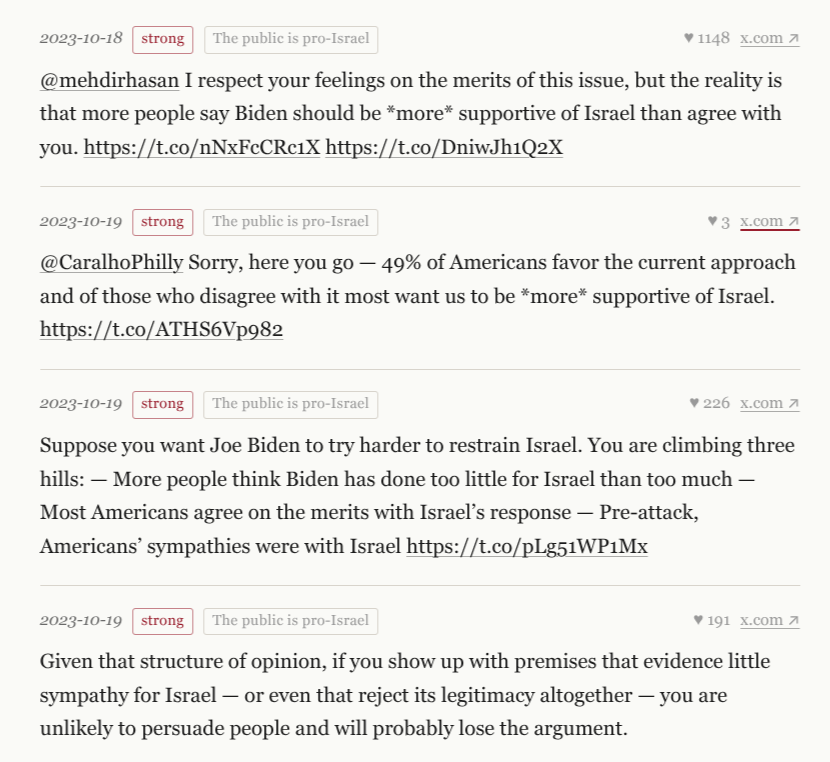
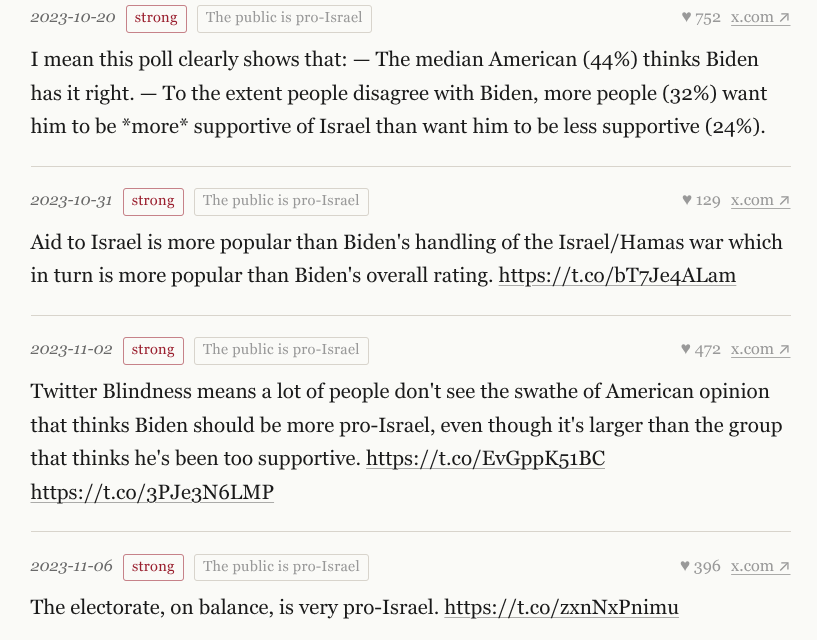
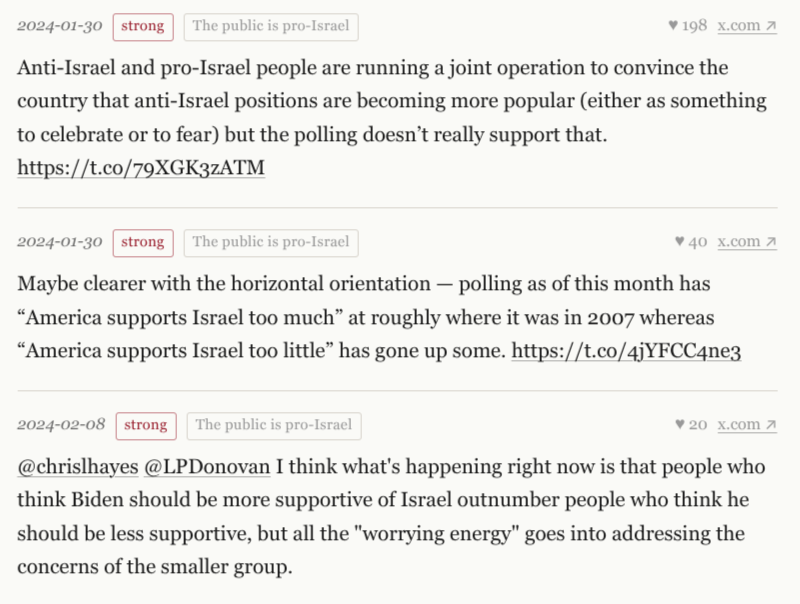
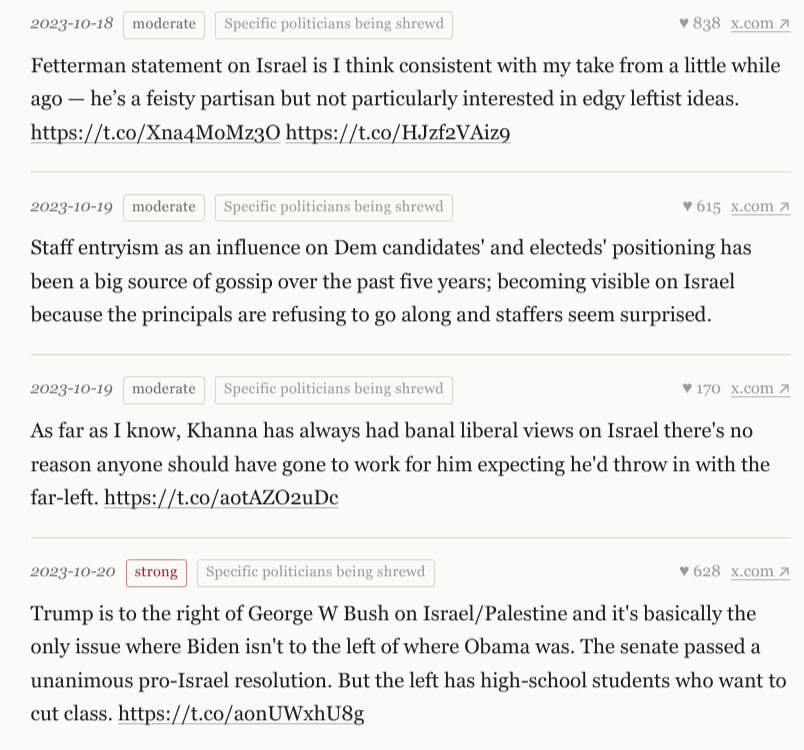
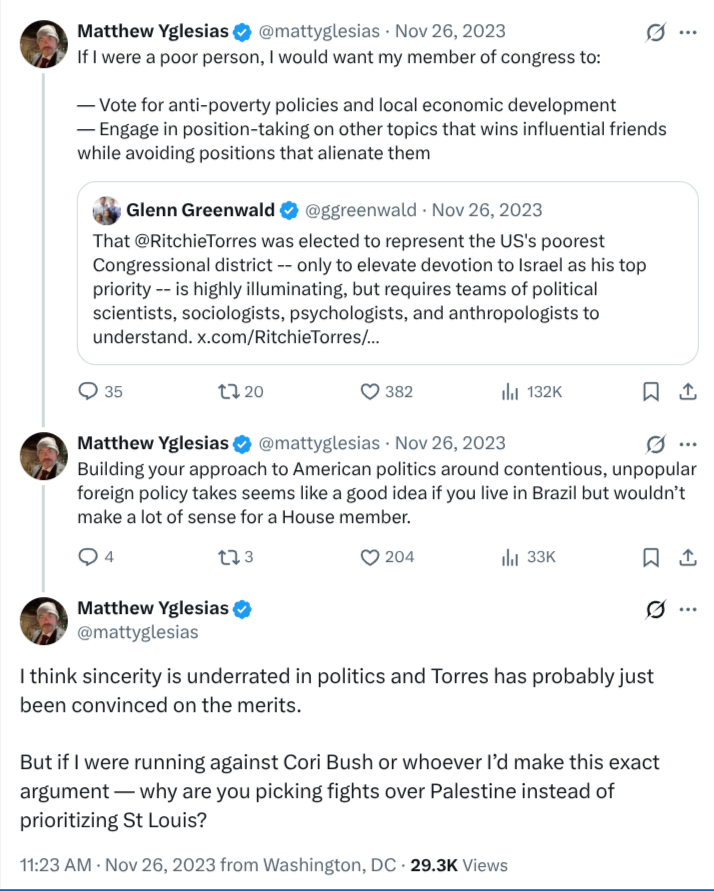
The last screenshot is the one that piqued my interest in all of this because it stuck in my head from when I first saw it nearly three years ago. Narrowly, on the merits, everything about it is backwards. All else equal, sending money to Israel is not good for the American poor, and as a matter of political rhetoric, it is pretty easy to say we should be spending that money on services at home. In the years since, that particular rhetorical line seems to have become fairly common and effective.
But Yglesias was not making a point about the policy merits. He was saying that Torres was, whether sincerely or not, being a smart political moderate because he was doing good position-taking. Just two years later, three members of Congress in Torres-adjacent NYC districts were primaried by people who were, to a large extent, running against the pro-Israel positions of the incumbents. Torres did not face a similar sort of challenge this go-around. He may have won even if he did. But it's hard to believe today that his past pro-Israel position-taking is a political asset that is helping his impoverished constituents.
The same is true for other politicians, not just Ritchie Torres, who shrewdly followed the polls in 2023 and now have a record on Israel that puts them at odds with the majority of Americans and the vast majority of Democrats.
Earnest Politics Are Unavoidable
The problems with this sort of strategic moderation are not just that you can get burned by a rapid change of public opinion. There is also something more conceptually troubling about it, which is that it is, in a Kantian sense, not universalizable. If everyone were to try to deduce what the median is and then adopt that view, then there would be no median. To have a median, you need people to earnestly engage in political opinion formation and political advocacy that generates a distribution of political views. Yet, this sort of earnest political engagement, which is what makes strategic moderation possible at all, is regarded as naive and reckless by strategic moderates.
These days, Yglesias has, in the spirit of strategic moderation, said that Democrats should actually bash Israel. That is, after all, what the current median requires. But if everyone took his advice in 2023, then the median would have never moved to the current anti-Israel position.
To the extent that Yglesias tries to deal with these paradoxes, it's by imagining that it's possible to simultaneously be moving public opinion in your direction without that bleeding over at all into the electoral process. But these two things are obviously intertwined. There is no secret place where you can spread your ideas away from the ears of voters and winning politician support is part of the process of moving public opinion.
Yglesias's favored example on this point actually proves the opposite. On Twitter and elsewhere, Yglesias likes to point out that gay marriage advocates did not press Obama to run as a gay marriage proponent because they knew it was not yet popular enough at the time and Obama had given reassurances that he was actually lying about his views on gay marriage. Yet, these same gay marriage advocates had in the 1990s and 2000s, pursued state-level lawsuits aimed at legalizing gay marriage as part of a long-haul strategy of changing public opinion. Some of these suits succeeded, but they also generated public backlash in the form of state-level constitutional amendments banning same-sex marriage. It was in this back-and-forth that a durable public consensus in favor of gay marriage was forged.
Free-riding off of earnest politics by having others do it and then, as if floating above it all, putting your finger on the median and going "there" can be very psychologically satisfying. It makes you feel like you are one of the only serious people in politics. But what it really does is turn yourself into a non-factor, someone whose political views twist in the wind based on how persuasive other political actors — the ones who don't engage in strategic moderation — end up being.